

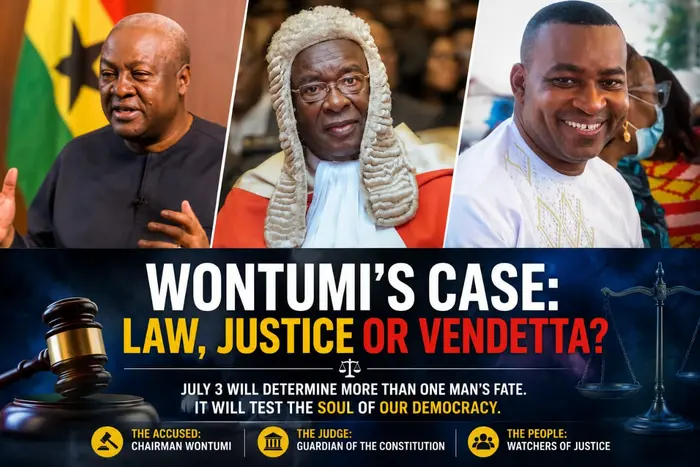
The date has arrived, and with it, a tidal wave of anticipation, opinion, and raw emotion. July 3 has become more than a calendar marker; it’s become a mirror held up to a justice system under scrutiny. In political arenas worldwide, the line between due process and political theater is often blurred. In this case, the question we must ask is whether the public spectacle around a high-profile case helps illuminate justice or merely stages retribution in broad daylight.
When the Deputy Attorney General publicly announced that judgment in Chairman Wontumi’s case would be delivered on July 3, 2026, it immediately intensified public debate. For many observers, the confidence surrounding the announcement appeared to suggest that the destination of the trial had become as much a subject of discussion as the journey itself. This is precisely why the events of July 3 must be viewed through a broader lens. The issue before the nation is no longer merely about allegations of illegal mining. It is about the integrity of due process, the perception of fairness within our justice system, and the dangerous intersection where law and politics often collide.
A date can become a powerful symbol. It can reassure, or it can threaten. If the judiciary is seen as predictable, transparent, and insulated from political windstorms, a target date can reinforce faith in the system. If, however, a target date becomes a weapon—a signal that outcomes are preordained or contingent on the axis of political convenience—then justice begins to resemble performance art, with jurors and witnesses as unwilling audience members.
There are three central tensions at play:
1) The perception of independence versus the optics of influence.
A credible judiciary must operate with independence, free from the sway of public opinion or political pressure. Yet the public cannot ignore the optics of a countdown that coincides with a broader political conversation. The challenge is to separate genuine legal reasoning from political theater. The courtroom, in this view, is less a stage for a verdict and more a forum for evidence, argument, and the rule of law.
2) Due process as a non-negotiable standard.
The core of any justice system is due process: fair notice, rigorous standards of proof, impartial juries or judges, and transparent procedures. When a date is announced with fanfare, it should serve as a beacon of procedural clarity, not a beacon of impending conclusions designed to fit a narrative. The integrity of due process requires that the verdict, if and when delivered, rests on fact and law, not on the clock.
3) The risk of conflating anti-corruption zeal with political vengeance.
Even in societies wrestling with the scourge of corruption, justice must resist the temptation to become a tool of punitive public sentiment. The danger lies in rewarding political wish-fulfillment rather than factual accountability. If July 3 becomes a referendum on power rather than a measure of truth, trust erodes on both sides of the verdict.