
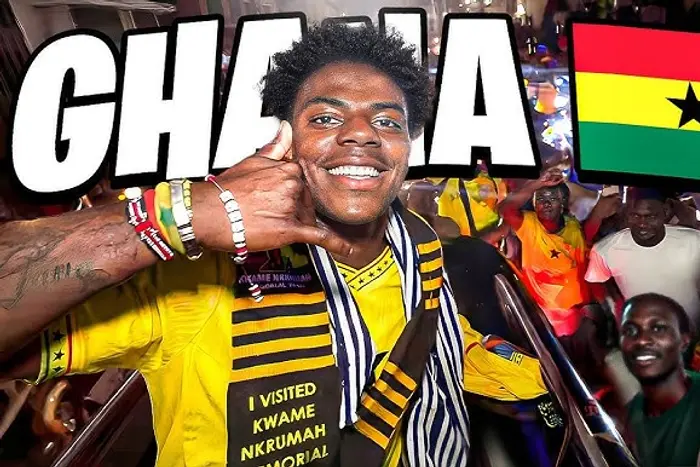
In a moment that wowed fans and sparked countless reactions, Popular American streamer and internet personality IShowSpeed has sparked reactions across social media after a resurfaced video showed him joking about representing Ghana, the United States, or Portugal at the 2030 FIFA World Cup. The 21-year-old content creator, whose real name is Darren Watkins Jr., made the light-hearted remarks during a livestream while reflecting on his journey from being a teenage streamer at the 2022 FIFA World Cup in Qatar to becoming one of the world’s most recognised online personalities.
Speed’s pop-cultural pivot isn’t new, but the way fans have grabbed onto his 2030 World Cup quip is. His playful tease—“Four years ago, I was 17 and streaming at the World Cup. Now I’m 21, and I will be 25 at the next World Cup. In 2030, I’ll be playing in the World Cup for Ghana, the USA, or Portugal”—was delivered with the infectious humor that built his online empire. The moment quickly ricocheted across Twitter, YouTube, and TikTok, reigniting a long-standing debate about national eligibility, dual citizenship, and the glamor of playing at football’s biggest stage.
Is Speed serious about donning the Black Stars kit in 2030? Probably not… at least not in the way traditional players do. His public persona thrives on cross-cultural banter, meme-friendly moments, and ambitious what-ifs. Yet the idea has real resonance in a country like Ghana, where the Black Stars’ global brand has grown far beyond the local pitch. If Speed ever truly pursued a change of allegiance—or if FIFA’s regulations opened a pathway—his influence could boost viewership, sponsorships, and youth engagement for Ghanaian football.
What makes this scenario sticky is the blend of Speed’s online power and Ghana’s ever-expanding footprint in global football conversations. Speed’s audience spans continents, and his comment—even as a joke—casts a spotlight on the potential for cross-border football identities in the internet era. For Ghana, a nation with deep football roots and a growing digital footprint, his name adds a modern twist to the country’s World Cup narrative.
Of course, the reality check is straightforward: national team eligibility isn’t a light switch. The process involves strict FIFA rules about residency, citizenship, and switching allegiance, often after a formal period of national team inaction. But in a world where athletes regularly cross borders in a single click and fans debate national loyalties with the same fervor as tactical systems, Speed’s playful prophecy becomes a bigger story about branding, reach, and the new-age “what if” of international football.
What fans are saying online spans the spectrum. Some celebrate the idea as pure entertainment, a fantasy collaboration between a global streamer and a revered footballing nation. Others caution that Speed’s comments should be interpreted as jokes, not serous intent. Still others wonder how a platform-first personality could influence the sport—perhaps drawing younger viewers to the Black Stars or inspiring a new generation of Ghanaian fans to rally behind the national team.
If nothing else, the moment shows how the internet can amplify the allure of a World Cup journey years before the first kickoff. It also invites broader conversations about national identity in a hyper-connected era, where players often build their brands far from the fields where they perform.
Must READ: Why are players wearing pink boots at the 2026 FIFA World Cup? That side note keeps popping up in conversations about evolving football fashion, and it’s a reminder that the sport’s aesthetics often travel just as quickly as its players’ careers. Such curiosities—boots, kits, and viral soundbites—are part of what makes modern football so intertwined with culture, media, and memes.
Bottom line: Speed’s 2030 World Cup remark might be more about entertainment and brand potential than a serious platform to switch nations. But it’s exactly the kind of story that demonstrates how football’s reach has expanded beyond stadiums and training grounds into the realm of global pop culture. For Ghana, the United States, and Portugal, it’s a timely reminder that the World Cup is as much about storytelling as it is about tactics, and that a single livestream can plant a seed that grows into a larger, football-fueled conversation.
If you’re curious how this unfolds, stay tuned to the online chatter and official football channels—because the 2030 World Cup is still years away, and Speed’s next big moment could come with a pair of headphones and a webcam, changing the game in unexpected ways.