
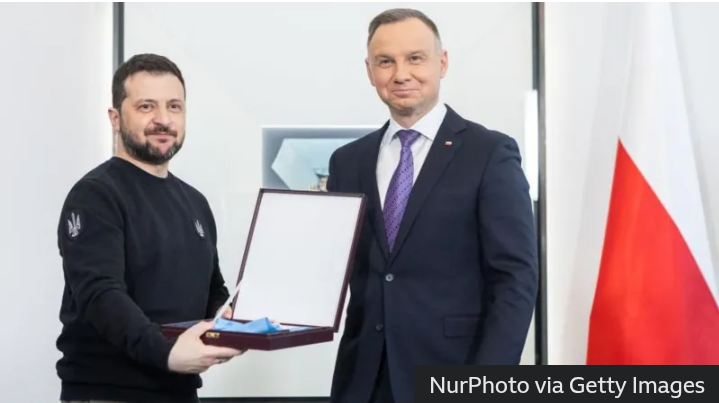
Ukraine’s Volodymyr Zelensky has been stripped of Poland’s highest state honour, the Order of the White Eagle, over Kyiv’s decision to name a military unit after controversial World War Two fighters. The move has stoked a sharp diplomatic clash between Warsaw and Kyiv, even as both capitals reaffirm their cooperation against Russia.
What happened
- Polish President Karol Nawrocki labeled Ukraine’s decision late last month to name the unit after the Ukrainian Insurgent Army (UPA) as “outrageous,” “incomprehensible,” and “deeply disappointing.”
- Nawrocki stressed the diplomatic row would not impact Poland’s support for Ukraine against Russia.
- Ukraine’s Foreign Minister Andrii Sybiha denounced Warsaw’s move, calling it a “strategic mistake” and “disrespectful.”
The UPA debate in context
- Many in Ukraine regard the UPA, which existed in the 1940s and 1950s, as heroes who fought for Ukrainian independence against the Soviet Red Army as well as Nazi Germany and Polish authorities. So for Ukrainians the title “Heroes of the Ukrainian Insurgent Army” is a major honour.
- Poland, however, accuses the UPA of carrying out a genocide of ethnic Poles in Volhynia (now Volyn in Ukraine) in 1943-45.
Raw reactions
- Nawrocki: “For the overwhelming majority of Polish society, the UPA remains, above all, a formation responsible for the brutal crimes committed against citizens of the Republic of Poland during World War II.”
- Kyiv’s response centers on the broader alliance against Russia, insisting the decision complicates historical reconciliation but not the current security partnership.
What this means for Poland–Ukraine ties
- The rift underscores how history and memory politics can collide with wartime alliances. Yet both governments emphasize ongoing support against aggression and a shared interest in deterring Moscow.
- The episode serves as a reminder that symbolic acts—like naming a unit—can have outsized diplomatic ripple effects, even when practical military aid and strategic cooperation continue.
Bottom line
The row over the UPA-named unit has forced a clash between commemoration and reconciliation. Zelensky’s loss of Poland’s highest state honour marks a rare public deterioration in a bilateral relationship otherwise dominated by mutual security concerns. As both sides navigate the fallout, the underlying alliance against Russia remains the unifying thread, even if the past continues to complicate the present.