

In a political landscape that moves at the speed of a tweet, a single sentence can feel louder than a policy memo. The latest wave in the chatter around U.S.-Taiwan relations centers on a bold, controversial, and potentially consequential claim: a former president says he will speak to Taiwan’s leadership in a way that breaks from tradition. Whether you see it as a blip or a bellwether, the idea raises questions about protocol, U.S. commitments, and what a shift in tone could mean for a region already on edge.
- The heart of the claim
- The stakes of the “how” and “why”
- What this means for the future of diplomacy with Taiwan
A noisy, but revealing, moment in a long-running story
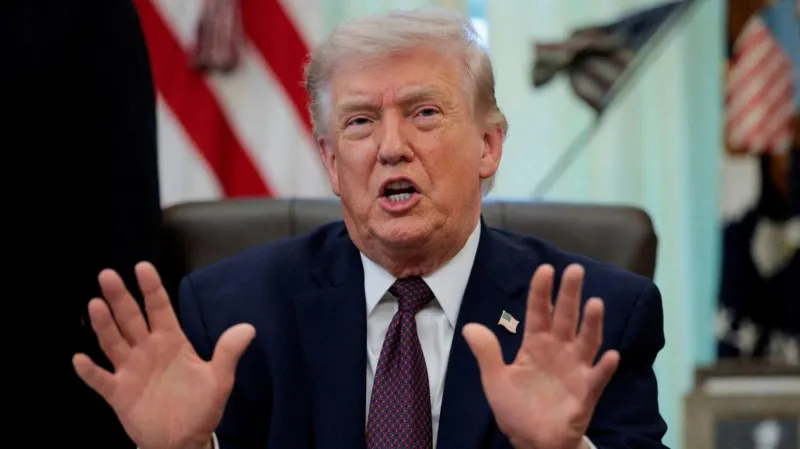
The core of this discussion is captured in a line that sounds almost sensational in a world of carefully choreographed diplomacy: “US President Donald Trump says he will talk to Taiwanese leader Lai Ching-te about a possible arms sale, in what would be a sharp departure from diplomatic tradition.” It’s the kind of sentence that begs for a hot take, but the more interesting question is not simply “Did he say it?” but “What would such a move signal in the broader arc of U.S.-Taiwan relations?
To understand the potential implications, it helps to recall the frame of the last several decades. The United States has navigated a delicate balance since 1979, when Washington severed formal ties with Taiwan to recognize the Beijing government. Since then, the two sides have maintained a substantive but unofficial relationship, with defense and security ties evolving in the shadows of a formal diplomatic distance. The line drawn by that long-standing arrangement is not a single point of policy, but a tapestry of legal constraints, strategic ambiguities, and political signaling that keeps the status quo from becoming policy catastrophe—yet never fully insulates either side from risk.
Beijing’s claim over Taiwan remains a rock in the cartography of regional security. The Chinese government has long asserted that Taiwan is a renegade province and has not ruled out taking it by force. That posture—threats, drills, and a persistent drumbeat of claims that Taiwan must unify with the mainland—complicates every conversation about arms sales, high-level meetings, and back-channel diplomacy. In that context, any departure from protocol—let alone a potentially direct line of communication across the strait—could be perceived in Beijing as a destabilizing move, even if the stated intent is to reinforce deterrence and defense.
Bang for the bucks: why “protocol” matters
Diplomatic protocol isn’t just pomp; it’s a functional framework that helps prevent miscommunication at moments when tensions are high. Breaks from protocol—whether it’s a direct conversation that bypasses usual channels, a public pledge of support, or a sudden shift in arms policy—carry risk. They can signal intent, shift perceptions of who holds the initiative, or redraw expectations about what allies can and should do in a crisis. In the Taiwan context, the protocol-load carries a heavier weight given the historical framework and the fragile equilibrium that currently sustains cross-strait relations.
The Lai Ching-te factor: leadership and deterrence
Lai Ching-te, who took office in 2024, has been described by observers as a leader who has pushed one of the strongest defenses-building campaigns in years. If a conversation about arms sales or security assistance enters a more direct, higher-profile track between a former U.S. president and Taiwan’s leader, it could be interpreted in multiple ways. For supporters, it could be viewed as a signal of renewed U.S. willingness to engage more transparently on defense matters with Taiwan, potentially strengthening deterrence against coercive moves. For critics, it could appear as a destabilizing escalation that raises the temperature on a volatile region and creates uncertainty for the mainland and regional partners.
The “why now” question is as important as the “what if”
Arguments for a more outspoken or direct approach often rest on the premise that Taiwan needs clearer signals of American commitment. The logic goes that a stronger defense posture—supported by reliable arms sales and political backing—can raise the costs of any aggressive attempt to force reunification by coercion. Critics, however, worry about provoking a reactive cycle: Beijing increases pressure, Washington signals intensity, and the region recalibrates with a new tempo of drills, deployments, and political posturing. In that environment, a single high-profile break from protocol can become a trigger point, accelerating risk rather than dampening it.
A reader’s guide to the terrain