

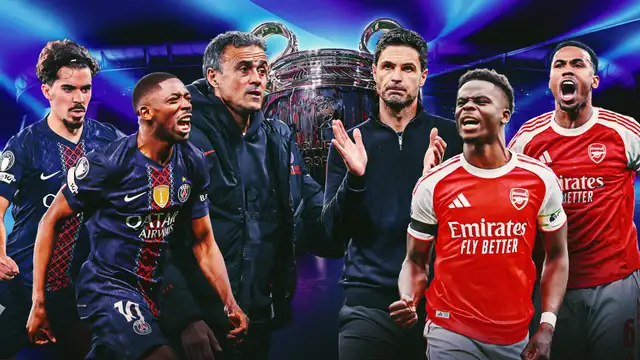
The Champions League final between Arsenal and Paris Saint-Germain promises to be a tactical chess match as much as a spectacle. Here are the six battles that could tilt the balance on the night.
1) The midfield duel: Odegaard vs Verratti (creative control vs cover)
Arsenal’s captain-driven midfield engine, led by Martin Odegaard, will try to knit counterattacks and quick transitions. PSG will counter with a mix of scrappy ball-winning and surges from their number eights. The battle is not just about who passes best, but who determines the tempo. Odegaard’s ability to unlock lines with inventive through balls could loosen PSG’s high line, while Verratti’s guile and decision-making under pressure can slow play and force errors. The key: which team can sustain quality pressure without losing shape when the other side tightens the press.
2) The wingers and full-backs: Saka and Martinelli’s pace vs Hakimi and Mendes’ width
Arsenal’s wide attackers thrive when the pitch spaces open. Haut-velocity runs, one-twos, and timing of their diagonal balls will stretch PSG’s defense. PSG will rely on their full-backs to pin back Arsenal’s attackers and create overloads on the opposite flank. The clash will hinge on whether Arsenal can maintain vertical threat without sacrificing balance, and whether PSG’s wide players can repeatedly threaten behind the back line to force defensive rotations. Expect a mix of quick transitions, late runs from deep, and crucial crosses into the box.
3) The central defender duel: Saliba vs Ramos (youthful bravado vs experience and leadership)
William Saliba’s measured defending could be Arsenal’s backbone, cutting out triangles and organizing the backline. PSG’s central pairing, with an experienced leader, will aim to cut out arcs and limit space for Arsenal’s forwards to exploit. This is a contest of anticipation and physicality: who can win duels on the edge of the box, who can clear dangerous balls under pressure, and who can keep the line compact when the other side pushes numbers forward. The winner here will also dictate how aggressive the opposing attack can become in the final third.
4) The goalkeeper confrontation: Ramsdale vs Donnarumma (shot-stopping, command, and distribution)
Goalkeepers can decide finals with a single moment: a decisive save, a decisive distribution, or a commanding call to organize the defense. Aaron Ramsdale’s reflexes, handling of high balls, and distribution will be tested by PSG’s pace in behind and the accuracy of their passing lanes. Gianluigi Donnarumma, equally capable of a game-changing moment, will be asked to cope with Arsenal’s pressing and the unpredictability of their forward runs. A clean sheet or a timely stop in a key moment could swing confidence for the next phase of the game.
5) Set-piece science: Arsenal’s set-piece routines vs PSG’s aerial threat
Set pieces are often the deciders in tightly contested finals. Arsenal’s attacking set plays must be executed with precision to break down a PSG defense that can be organized by experience and height. Conversely, PSG will look to exploit Arsenal’s zone or man-marking tendencies on corners and free-kicks. The battles here are won by the team that can deliver quality crosses, win the physical duels at the edge of the area, and convert opportunities when most teams struggle. A well-placed free-kick or a late corner following a frantic phase could prove decisive.
6) Bench and game-management: Arteta vs Galtier (rotation, momentum, and in-game adjustments)
Squad depth often separates champions from runners-up. The managers’ decisions on substitutions and tactical shifts will be scrutinized. Will Arsenal go for a high-pressing, high-energy approach for 60 minutes, then switch to a tighter, counter-attacking shape? Or will PSG attempt to run the game with measured, controlled possession to tire Arsenal’s press? The side that reads the match correctly, makes timely changes, and adapts to the opponent’s plan will have the edge in the closing phases.