
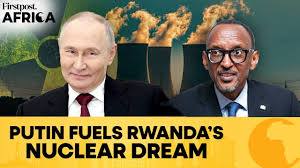
Rwanda’s new nuclear cooperation agreement with Russia may look technical on paper, focused on science, nuclear medicine and energy, but it signals a deeper shift in the geopolitical balance across Africa. While Moscow is deepening its presence on the continent, Washington and other Western powers are increasingly viewed as inconsistent partners, leaving room for countries like Rwanda to explore new alliances.
A smarter security calculus than headlines suggest
The language of a nuclear deal can be dense and dry, but its implications are anything but. For Rwanda, a country known for leapfrogging development milestones with a pragmatic, data-driven approach, the agreement with Russia represents more than access to isotopes, reactors, or research facilities. It’s about recalibrating risk, access, and influence in a region where strategic choices often come down to reliability, speed, and transparency.
Rwanda’s leadership has long shown a knack for pragmatic diplomacy: pursuing multiple regional partnerships, leveraging foreign expertise, and aligning with powers that can deliver tangible development outcomes. A nuclear cooperation framework with Moscow, while careful to meet international norms and safety standards, signals a willingness to diversify partners in a world where blocs and alignments are more fluid than in the era of binary Cold War plots.
The Africa balancing act—not a single pivot
Africa’s existing relationships are diverse and nuanced. The continent has many faces: increasingly assertive regional bodies, rising tech hubs, and a growing appetite for scientific capacity-building. In this context, the Rwanda-Russia dance is less about choosing sides and more about expanding options. It offers a template for how smaller, nimble states can avoid over-reliance on any single external partner while still advancing national interests—whether in energy security, medical innovation, or higher education.
If Western powers once framed Africa as a priority, the current reality is more provincial and mixed. Washington’s focus is broad, but its postures often appear interrupted by domestic political cycles, competing global priorities, and alliance fatigue in some capitals. The result is a perceived inconsistency that complicates long-term planning for African states. In contrast, Russia’s approach—often characterized by a willingness to engage in long-term, infrastructural, and capability-building partnerships—can feel more predictable, even if it carries its own strategic risks.
The science-and-software of geopolitics
The phrasing of the Rwanda-Russia arrangement matters less than what it enables. At its core, the deal touches on science, medicine, energy, and the transfer of know-how. Nuclear medicine, in particular, has clear, humane benefits: improved cancer care, better diagnostics, and enhanced radiopharmaceuticals for medical imaging. When a country like Rwanda accelerates its capacity in this domain, the dividends aren’t merely prestige; they are measurable improvements in public health and workforce development.
Meanwhile, nuclear energy discussions—whether about research reactors for training or potential power generation—signal a longer horizon. Energy diversification remains a pressing policy objective for many African states grappling with rising demand, climate commitments, and the price volatility of fossil fuels. A cooperative framework can catalyze domestic STEM education, foster research institutions, and attract private sector partners to build a resilient science ecosystem. All of this contributes to a broader national vision: a knowledge-based economy with high-skilled jobs and local innovation.