

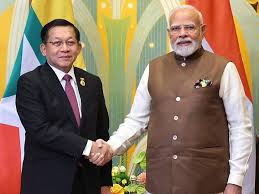
Less than two months after he completed a carefully engineered transition from Myanmar’s junta chief to become president, Min Aung Hlaing will fly to India on an official visit on Saturday, his first overseas visit since taking the civilian role. The five-day trip, during which the former general will hold talks with Indian Prime Minister Narendra Modi, underscores the gradual return of regional re-engagement for Myanmar, five years after many of its neighbours shunned the Southeast Asian nation\’s military leadership following a coup.
As Min Aung Hlaing lands in New Delhi, analysts say the trip signals more about regional geopolitics than merely ceremonial diplomacy. India, hovering between strategic partnership and caution, is weighing how Myanmar’s evolving political reality—under a leader who rose from the ranks of the army that seized power in 2021—fits into broader regional calculations, especially vis-à-vis China.
Why India matters for Myanmar
- Pragmatic diplomacy: After years of diplomatic frost, Myanmar’s leadership is testing the waters with neighbours that were quick to criticize the coup but are wary of destabilizing the region further. India’s invitation underscores a desire to keep channels open for trade, security, and development cooperation, even as Western partners recalibrate their approach.
- Economic outlook: A five-day agenda typically blends talks on infrastructure, trade, and investment with people-to-people ties. For Myanmar, access to Indian markets and investment could help diversify away from a China-centric economic footprint, while also offering a counterweight to regional rivals.
- Security calculus: With internal turmoil and resistance to military rule persisting, India’s stance is likely to emphasize stability, constitutional norms, and cross-border cooperation on counterinsurgency and counter-terrorism—areas where regional neighbors have shown interest in coordinated approaches.
Min Aung Hlaing’s China angle
Myanmar’s China ties loom large in any regional assessment. Beijing remains a major economic and political partner, and its influence stretches across Myanmarese infrastructure and trade corridors. The Indian visit may be viewed through a balancing lens: how far Myanmar leans into New Delhi’s orbit without jeopardizing its important relationship with Beijing. For China watchers, the trip tests whether Myanmar can sustain a multi-vector diplomacy that hedges against over-reliance on any single heavyweight in a tense neighborhood.
Regional re-engagement: slow but deliberate
Five years after many of its neighbours shunned the Southeast Asian nation\’s military leadership following a coup, Myanmar appears to be treading a cautious path toward re-engagement. The India trip embodies a broader pattern: occasional high-level visits, selective economic deals, and a renewed, if fragile, diplomatic routine that aims to normalize exchanges without fully normalizing the legitimacy of Myanmar’s military rulers.
What to watch next
Follow-on diplomacy: Will other neighbors follow India’s lead, or will they maintain a cautious stance while monitoring the evolving domestic scene?
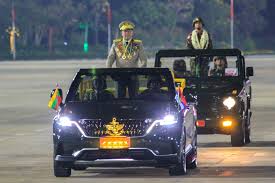
Public reception and domestic messaging: How will this visit be framed domestically, and what signals will be sent about the legitimacy of the civilian veneer under Min Aung Hlaing?
Economic commitments: Any announcements on infrastructure projects, energy, or manufacturing could hint at Myanmar’s longer-term economicPivot and its regional alignments.