

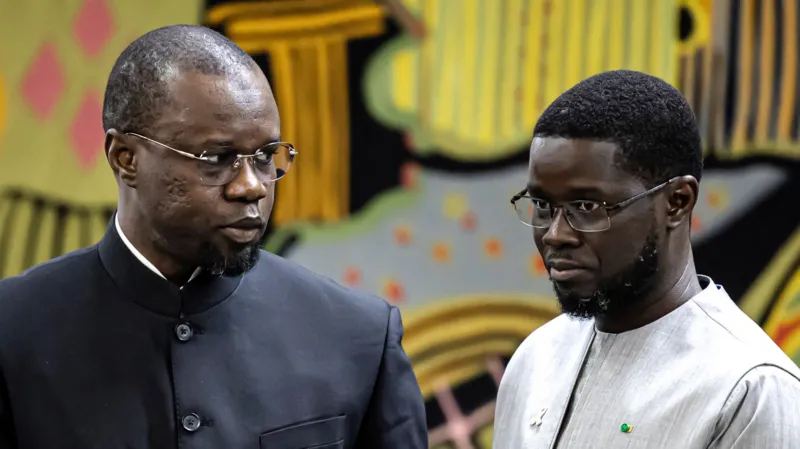
In a move that has stunned observers and rattled the political fabric of Dakar, Senegal’s president has sacked his prime minister and dissolved the government after months of tensions. The unusual rupture between two longtime political players—one who promised reform and the other who rode a wave of youthful energy—has unsettled markets, vexed allies, and raised questions about the road ahead for a nation balancing ambition with restraint.
A shock decree, read out on TV by a presidential aide, said Faye had “ended the duties” of his one-time political ally Sonko and “consequently those of the ministers and secretaries of state who are members of the government.” The language is stark, and the moment is symbolic: it signals not just a personnel change, but a recalibration of power, loyalty, and the path forward for a country that has long prided itself on political stability in a region not short of volatility.
The players are well-known to Senegalese—Bassirou Diomaye Faye, the man at the seat of executive power, and Ousmane Sonko, a charismatic figure who mobilized a large following among the youth and positioned himself as a challenger from the margins. The split did not happen overnight. It unfolded against a backdrop of economic strain, social energy, and a sense that the country’s political class might be unable to keep pace with the demands of a growing, restless citizenry.
In many ways, the timing could not be more delicate. Senegal’s public debt has climbed to a level that alarms investors and worries policymakers: 132% of GDP, according to the IMF. That figure—large by any standard, particularly for a country lauded for its democracy—puts strain on public services, public investment, and the government’s ability to deliver on promised reforms. When you couple fiscal pressure with a dramatic reorganization in the upper echelons of power, you invite a flood of questions: Will markets react with caution or panic? Will opposition voices view this as a chance for renewal or a bid to smother dissent? And what of the powerful youth movement that once saw Sonko as a vehicle for change—how will it respond to a leadership reshuffle?
The decree’s wording, stark and rapid, underscores the brusque nature of the split. By ending the duties of Sonko and those of the ministers and secretaries of state who are members of the government, the president signals not just a change in personnel, but a statement about accountability, loyalty, and the speed of political transitions. In political theater, such moves can either deflate tensions or inflame them, depending on how the rest of the administration handles communication, policy signals, and the business community’s appetite for certainty.
For Sonko, the reaction on social media—“sleep with a light heart,” he wrote—reads as a mix of defiant calm and a strategic calculation to retreat from the frontal stage while preserving a base of support. It’s a line that captures the paradox of leadership in a digital age: public fury and personal resolve can coexist, and the narrative a leader chooses to tell about the setback often matters as much as the event itself.
Analysts will be scrutinizing several threads in the days to come. First, the economic curve: how will the new administration stabilize or reorient fiscal policy? Will there be a credible plan to manage debt, reassure lenders, and protect social spending at a moment when credit markets are watching closely? Second, governance and legitimacy: with a government dissolved, who steps in, how quickly, and what signals of continuity or change will be offered to civil servants, investors, and international partners? Third, the social contract: how will this affect the relationship between the government, the youth-driven movements that propelled Sonko to prominence, and civil society’s appetite for reform without destabilization?
There is also a broader regional dimension to watch. West Africa has seen a spectrum of political experiments—from fragile coalitions to contested elections and, in some places, abrupt leadership changes. The Senegalese case, while unique, will inevitably be read through the lens of those neighboring dynamics: what does this say about the health of democratic processes, the power of executive action, and the resilience of institutions that are supposed to function even when the political winds shift?
One possible implication is economic signaling. International financial institutions and investors tend to react to governance changes with caution, weighing the probability of policy continuity against the risk of policy reversal. If the new arrangement can present a coherent plan—clear priorities for growth, job creation, and debt management—it could restore a measure of confidence. If not, the ensuing uncertainty could compound the country’s fiscal pressures and complicate ongoing reform programs.